
Tamil Nadu Chief Minister MK Stalin launched a sharp attack at Prime Minister Narendra Modi Friday ahead of his visit to the state, targeting the BJP-led federal government's new employment guarantee scheme – the G-RAM-G programme – and criticising the delay in release of funds.
The PM is due in Tamil Nadu later today to jumpstart the BJP campaign for the April election.
Stalin also hit out at the centre over the tussle between opposition-ruled states and their federal government-appointed Governors, which was evident this week after Tamil Nadu and Karnataka governors, RN Ravi and Thawaarchand Gehlot, walked out of their respective assemblies. That prompted a spat over constitutional propriety between the ruling DMK and Congress and the BJP.
In a long post on X Stalin said, "Prime Minister Modi, who frequently visits Tamil Nadu only when election season arrives... when will the Rs 3,458 crore education fund be released? When will the assurance that Tamil Nadu's constituencies will not be reduced in delimitation come from your lips? When will the tyranny of the Governor, who acts like a BJP agent, come to an end?"
But the highlight of Stalin's address to the Assembly this morning was a resolution against the G-RAM-G jobs scheme and a demand for its predecessor, the Congress-era Mahatma Gandhi National Rural Employment Guarantee Act, to be restored.
Reading out the resolution, Stalin also demanded the scheme's earlier financial architecture be brought back, i.e., the G-RAM-G scheme will operate under a funding structure that requires most states to pay 40 per cent of wages.
Opposition-ruled states, however, have argued this cripples the critical social welfare scheme since most of them the financial resources to take on an estimated Rs 56 crore wage bill.
Tamil Nadu is now the third opposition-ruled state to move an anti-G-RAM-G resolution after Punjab (on December 30) and Telangana (on January 2). Karnataka, ruled by the DMK's ally, the Congress, is expected to do so later this month after chaos in its Assembly this week.
Punjab and Telangana criticised the new scheme as an attack on the country's federal structure and the rights of rural workers, and flagged the dilution of employment guarantees relative to MNREGA, the added financial burden, and potential harm to women and vulnerable groups.
The G-RAM-G jobs scheme cleared Parliament last month despite ferocious protests from the opposition. The government defended its new scheme by stressing the need to update the 20-year-old MNREGA that it said was inefficient and riddled with corruption. It also pointed to an increased minimum number of workdays – from 100 under MNREGA to 125 under G-RAM-G.
G RAM G explained
The main points (at least the ones most discussed by lawmakers) of the new legislation are the guaranteed workdays, the funding structure, and increased federal control over fund allocation, which the government described as "normative" rather than "demand-based", i.e., the centre will determine how much each state gets every year based on "objective parameters".
Guaranteed workdays: G RAM G offers an increased minimum number – 125 over 100 by MNREGA – but there are conditions, including notification of a 'rural area' by the centre.
READ | "Swear By My Mother, This Isn't Good For The Poor": Kharge On G-RAM-G
That is, employment guarantees under G-RAM-G will not extend to areas not listed as 'rural' by the central government. This point is carried over from MNREGA. In practice, though, employment then was offered across all rural districts, making it a pan-India scheme.
Funding logic: Under the MNREGA the centre paid around 90 per cent of all expenses, including wages and raw materials. That changes under G-RAM-G, with states required to pay 40 per cent of that amount, although hill states and those from the northeast need pay only 10 per cent.
Union territories will continue to receive 100 per cent funding in this regard.
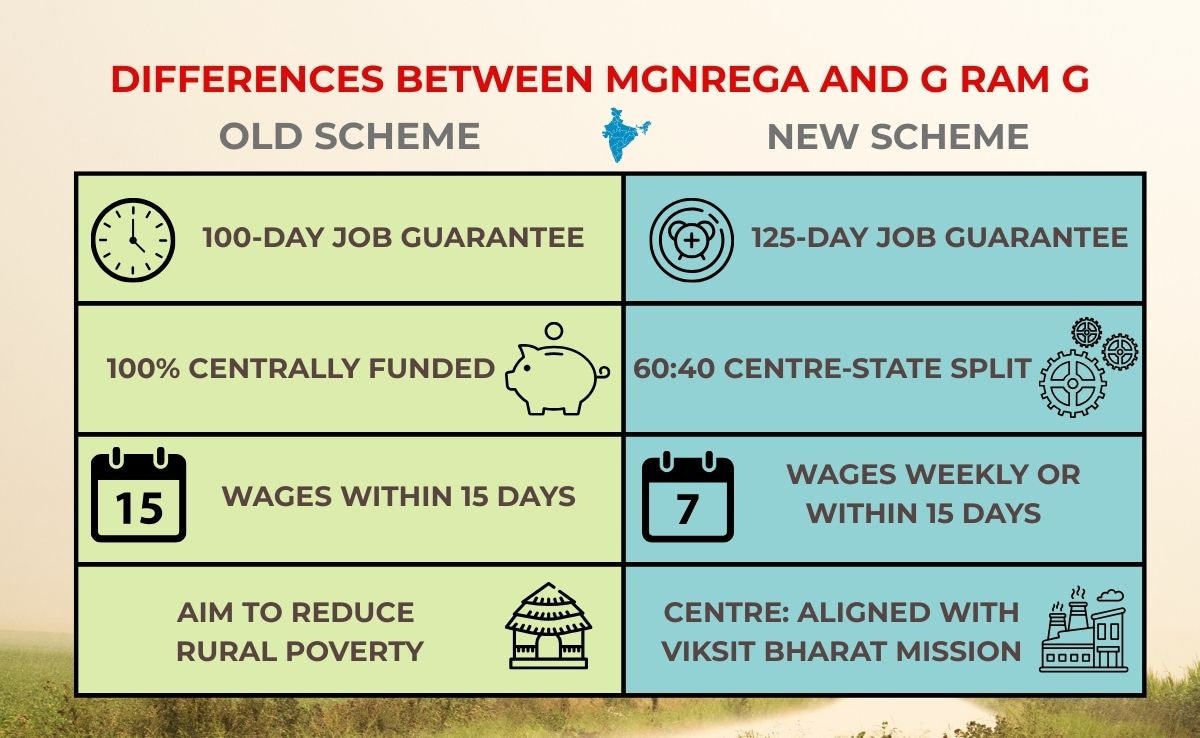
The change in the financing architecture, the government has argued, will encourage each state to take up financial ownership of the scheme in its territories. The opposition, though, argued this would further stress already fragile state-level finances, effectively reducing the scope of the scheme by limiting the amount of work available; the Congress called G-RAM-G "anti-poor".
The government has stressed this will not "impose an undue financial burden" and that the funding structure has been calibrated according to each state's fiscal capabilities.
The funding architecture is a flashpoint because it constrains – based on the centre's "normative allocation" – the amount of work each state can offer under the programme. It also means the centre can, if it chooses to, suspend funds "where serious irregularities are detected, and direct corrective or remedial measures to address deficiencies".
Work basket and who assigns it: At the ground level nothing changes. Work will continue to offered by the panchayat and/or programme officer at the grassroots.
What does change, however, is that under G-RAM-G the centre will set the standards, which includes regulating, in the case of construction work, for example, materials and designs, and limiting the nature of work 'approved' for payout from the allocated finances.
Also, the G-RAM-G scheme divides work into four categories – water security, core rural infrastructure, livelihood-related assets, and climate resilience. Critics said this curtails the scope of the work, which was earlier decided by panchayats according to local needs.
NDTV is now available on WhatsApp channels. Click on the link to get all the latest updates from NDTV on your chat.
from NDTV News- Special https://ift.tt/kpFKtgL